Showing posts with label glass. Show all posts

Monday, January 19, 2009

Chew on this ...

What do you do if your dog gets into your glassmaking supplies?

I'm currently dog-sitting for my ex-neighbor's two dogs, both of whom get along really well with Mr. Justin Wigglebutt, my rescue whatsit. Justin sleeps in his (open) crate in the study, because I can trust him not to chew the books on the lower bookcase shelves. Milo and Diamond sleep in the kitchen; although that's where my workbench is, neither dog has ever shown any sign of pulling things off the table. Until night before last, when Milo decided to take a taste of my workbench. I woke up to find Val Cox' Frit Secrets in a pile of gleefully ripped pages, along with parts of Passing the Flame and two half-packages of silver and gold leaf. Most alarmingly, there were chewed plastic bottles of frit, ripped sacks of shards, and loose shards and frit strewn all through the debris.

First of all, don't panic, but assess the situation as calmly as you can. Remember that most glass shatters at an angle that is more likely to pass safely through the intestine than ground glass or thin pieces, like shards. The larger the frit is the safer you are. After my first flush of sheer panic, I looked carefully at Milo; Diamond does not have a history of ripping things up, but Milo does. No blood on his gums, no glass or frit in the pads of his paws. I looked for the icky stuff--there was no diarrhea or bloody stool, and no blood around his anus. Given that what looked like all the frit was on the floor or still caught in the container, I was most worried about his involuntarily swallowing a piece or two, not a whole lot.

My second step was to call the emergency vet for advice, while pulling out some bread slices. Why bread? Bread is an old home remedy for any animal that's swallowed something sharp, such as bone fragments. It can coat the bone and help it pass safely through the intestine. The emergency vet confirmed that, and also said that unless the glass had lead in it, it would not show up on an x-ray. I did a fast Internet search and found the answers inconclusive. The vet didn't think there would be enough in Milo's system, so she told me to do the things I had already done--feed him bread (the other two were happy, because what you give to one ... ), and watch his behavior and his stools, and bring him in if he began to show blood, to vomit, or just to become lethargic.

Milo was wrestling with Justin, and clearly hadn't a care in the world. *I* was a nervous wreck. On my way to visit Art of the Firebird to pick up her unwanted dog crate (I could have put Milo in Justin's crate, but he does like to den in it, and AoF wants to get rid of the crate ASAP anyway) I called Milo's human to see if he wanted me to take any additional action, and to give him a heads-up about the situation. He said no, no emergency X-Ray in case; he agreed with me that it was unlikely that Milo had really *eaten* any of the glass, let alone enough of the glass to possibly show on an X-ray *if* there was lead in it.

Last night Milo slept, most reluctantly, in his new "box," which will be his permanent bedroom whenever he comes to stay with me. Diamond usually dens with him, but this time she stayed in the kitchen, and Justin slept in his blanket-covered crate. As you can see from the pictures, taken this afternoon, Milo is happy, healthy, and active (he's the littlest one; Diamond is the middle-sized Pit bull, and Justin is the largest Lab/Spitz). His only ocmplaint is that he had to sleep in a crate, rather than rrrrripping into things, eating more frit, and getting more bread.

But if you work with glass, and have dogs, I offer you both this cautionary tale and this medical method.

Wednesday, October 1, 2008

At the Show II: Bead Release and Tiffany Glass

One of the neat things about doing a show is that you get to talk to many interesting vendors. The owners of Forward Motion Arts were there. They were handing out samples of a new bead release that they have formulated. Bead release is basically kiln wash, and kiln wash is basically kaolin and alumina hydrate. Some add graphite, or nepheline syenite, or diatomaceous earth. It's easy to mix, but one doesn't want to breathe the release in while reaming beads, which is why, unless I am very broke, I use commercial releases. My favorite so far has been Foster Fire Smooth 'n Tuff

The thing that is so exciting about that is that most bead releases have been formulated with the dry inter-mountain west in mind, or the humid but cool western coast. Here in the subtropical south, many bead releases crack, flake, or just won't hold. Most people I know who torch in this region use a mix of commercial products or make their own. However, Forward Motion Arts has a new release that was formulated and tested here in the humid South! I am looking forward to working with it. Like all good releases, it can be air or flame-dried (i.e. wafted in and out of the torch flame to speed drying).

The owner of Forward Motion Arts also had a special present for all of the flameworkers at the show: three rods of assorted glass. What maker? we asked him. "There's a story," he replied. (The following text is from FMA's EBAY auctions.) "I bought these rods a couple of years ago from a supplier who had found them hidden in a warehouse in France. They had been sitting in their warehouse since the 1950s. There [were] only limited quantities of it in each of the colors and all the colors except one sold out within a few months. ... I have looked up the history of it and have found that opalescent glass is very rare. ... In trying to find out who made it and where did it come from, here is what I have found." What he found was that the glass was not produced in the 1950s, but in the 20s and 30s ... in the Tiffany color palette, likely by a member of the Tiffany family.

And he GAVE US SOME! One of each rod color. MMMMMM.


Sunday, July 6, 2008

New Technique: Tornado Beads

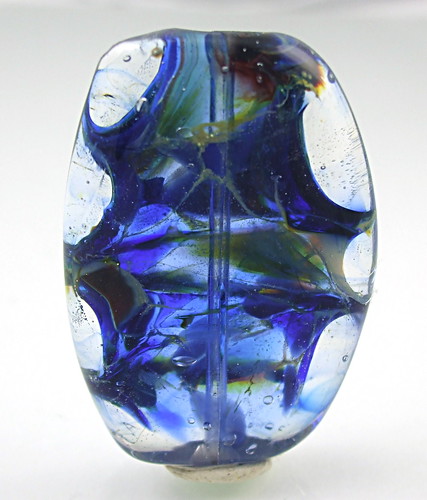
Over the weekend I tried a new technique--the tornado bead. There's an excellent tutorial on them by Margaret Zinser, and I have wanted to try them! A fellow team member, Elysium Beads, has a beautiful tornado bead example on ETSY, reproduced here as the first picture, and her bead gave me the necessary boost.

Meanwhile, as I wrote earlier, I was frit-testing one of my sister's unique frit blends. So I decided to use it as the base of my first tornado bead. It turned out very well indeed --- except that I was so caught up in the process of making the bead and keeping the base cool that I forgot the cardinal rule of lampworking larger pieces: insurance heat. Yep, the bead cracked right along the mandrel line. In the picture you see I've glued it.

But I really like that frit! I don't know if it has a problem with encasing, because the two beads I have made with it and encased have both cracked. Every other tornado bead I made in that session cracked, though, so I don't think there's enough evidence that the frit is at fault. I made a tornado bead yesterday that I heated more thoroughly, and that was fine. So I will try again, making some round encased beads and a new tornado bead; if THOSE crack, then it's the frit, alas. Encasing brings out such lovely colors in it, though.