
Before I start, I will acknowledge that Ms. Seibels has made an apology in her blog and on Lampwork, Etc (the thread there has been removed) for her statements about age. I am neither trying to flog Ms. Seibels or the proverbial defunct equine. Nor am I decrying Ms. Seibels' lampworking skill, which is quite good. I do, however, wish to state a rebuttal and to propose some alternative theories that might create her observed results.
"She says she stays on top of trends in lampwork beads by tracking the listings on Ebay ... from the traditional colors and shapes of beads created by the typical middle-aged bead artist to the more experimental pieces being created by younger artists just starting out" (22).
People who commented on this statement at LE in general did so in a polite yet firm way, though there were some who insisted on confusing the personal with the content. In her commentary on Ms. Seibels' apology, "Margot" wrote, "Those people are angry about a host of things that have little to nothing to do with you. They’re just looking for an outlet to vent their misplaced anger. They are the sorts of people who see the glass as having a huge hole in it and who feel that everyone else is stealing their piece of the pie." I argue that the comments by and large did not come out of a sense of misplaced anger or a fear of young, dynamic, up-and-coming artists. Instead, I propose that there are two issues at work in this statement to which we all were responding: ageism and methodology. Basically, Ms. Seibels is ascribing "traditional" designs to middle-aged beadmakers (how does she know?) and innovation to younger ones, on the basis of Ebay listings.However, she is ignoring other factors: demand for product, skill level, marketing, and the like.
First of all, creativity and innovation are by no means linked to youth, whereas traditionalism is hardly the province of the old. Some of the most innovative bead-makers I know are middle-aged and better. Barb Svetlick, Lydia Muell, Angelina Beadalina, Lisa St. Martin, Andrea Guarino-Slemmons, and Lance and Maureen McRorie all come to mind instantly. Browse through the annual Bead Review or 1000 Glass Beads, and you will see that innovation and creativity have nothing to do with age.
That refutation brings me to my second point, that of methodology. There are at least two assumptions lurking underneath the author's paraphrase of Ms. Seibels' statement (a close paraphrase, as Ms. Seibels proved on the unfortunately now-vanished LE thread). One is that Ebay is the primary venue for bead sales, and the second is that people put their best and most unique work out on Ebay rather than at other venues. I argue that both of these premises are problematic, for related reasons.
 There are multiple venues for bead sellers, both online (such as Etsy, the Annealer, gallery pages, and individual web sites, etc.,) and real-world (Bead and Button, Down the Street Bead show, The Gathering, et al). Ebay is only one of these, and one moreover that has proven increasingly uncomfortable for crafters. It would stand to reason, then, that many people would not be making the bulk of their sales on EBAY--or even appearing there at all.
 Those who do likely have product targeted to a specific audience. Frankly, simpler, more "basic" lampwork beads, with precise (i.e. pressed) measurements or simple rounds, are often what designers and buyers want. Many designers like simple beads for filler or background--less expensive, less eye-catching -- one can have only so many focals on a necklace, after all. Recently I listed an elegant organic set with strong colors on Etsy, but it hasn't attracted much attention. By contrast, a simple frit set (white beads rolled once in frit, melted, and c'est tout) gathered at least three hearts. Other frit sets of mine have done similarly well, one with (currently) ten hearts!
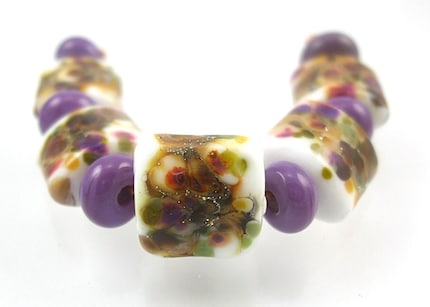 None are innovative, but all are nicely balanced. Lisi does very well with "simple" styles and beads. Don't let the "simple" confuse you--she has amazing skills -- and one of them is knowing what sells. Obviously, I am using a single experience to form a generalization, which is *also* problematic. But I would submit that Ebay functions as a marketplace, with all the attendant laws of supply and demand. If frit beads, traditional colors, and traditional designs are prevalent there, it might not be because that's all the beadmakers want to sell. Instead, it might be because those are the beads the market demands. What would you rather have, a single $80 bead, worth every penny, that takes weeks or months to sell, or 4-5 sales per week of a simple $20 strand of beads? If you're living on your lampwork income,or using it to save up for something, I bet I know the answer. That doesn't mean that the frit beads are the sum total of your skills. It just means you've found a niche and are filling it.
 Some people, therefore, may be using Ebay and (to a lesser extent) Etsy for their bread-and-butter beads, and selling others at different venues. I know at least three people who first sell their beads on their websites, and then take what doesn't sell there and at three shows to Etsy or to Ebay. Other people, like Jo Hoffacker, reserve their new stuff for galleries or for the Gathering. In other words, they know what sells where, and that determines some of what they make, and where they sell it -- not their ages or their amount of creativity. For the same reason, doing a search of Ebay to determine trends and general bead artistry will only show you what the larger mass audience wants to purchase, not the directions that bead artists are going for high-end or innovative work. It would be like going to Michael's Craft Store to figure out what new work the designers are planning to bring out. If I gauged my work by Michael's, I should be at the top of the bead world! However, since I gauge my work by the truly innovative out there, I rank mine at the beginning journeywoman stage. I am a competent and occasionally inspired bead crafter who has a very lot to learn still in terms of technique and design.
Publicity and a name can also affect both where you sell and how well you do. I have seen beadmakers with stunningly ordinary beads get $150 a bracelet just on sheer marketing knowledge and chutzpah. Do I begrudge them that success? No; what they lack in innovation they make up in sheer hard work, technical competency, and marketing skills (purchased or learned). Either way, it's earned. Ms. Seibels has the self-confidence and the marketing team down pat, and good for her.
All the same ... I'd like to close with a link and a quotation, directed both to Ms. Seibels and to myself. The link is to Gwacie's blog, in which she quotes some fantastic text by Angelina Beadalina. These words were aimed at those who copy, but I think they hold true for creativity, as well. The quotation comes from a text attributed variously to Miller H. Caldwell, Dale Evans, and to a seventeenth-century nun's text. (The historian in me strongly doubts the latter, simply because of word usage, but I digress.) "Lord, thou knowest better than I know myself that I am growing older and will someday be old. Keep me from the fatal habit of thinking I must say something on every subject and on every occasion ... release me from craving to straighten out everybody's affairs....with my vast store of wisdom it seems a pity not to use it all, but Thou knowest, Lord, that I want a few friends in the end."


 Posts
Posts


